

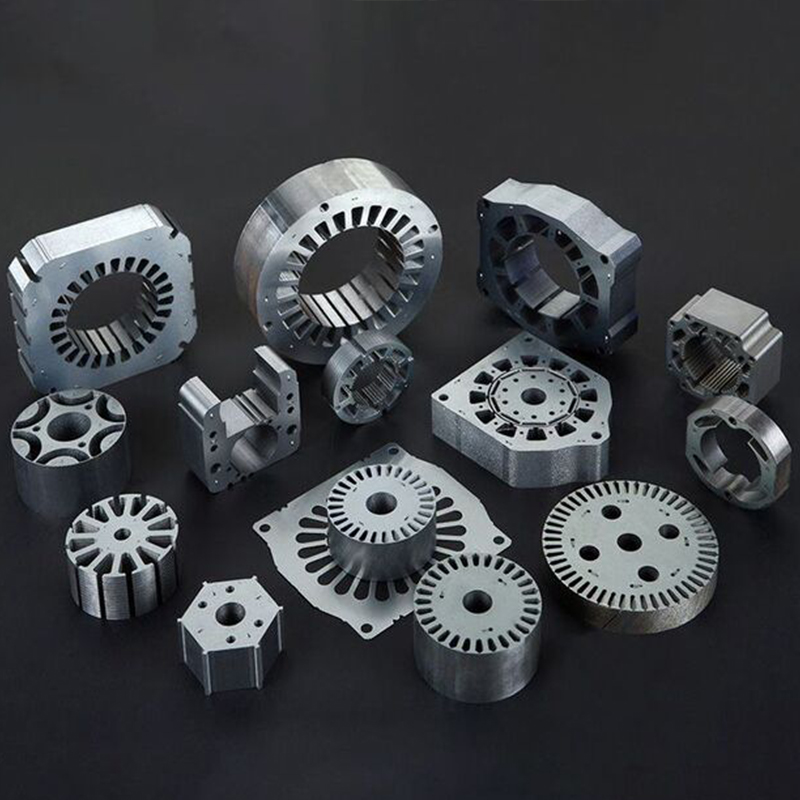
In the manufacturing of motor cores—especially those used in electric motors and EV applications—tooling precision, durability, and wear resistance are essential. The choice of tooling material plays a pivotal role in production efficiency and part quality. Among the most common materials used are High-Speed Steel (HSS) and Cemented Carbide, both of which are suitable for high-volume stamping and forming operations. However, in high-precision applications such as CNC Machining Components or Electrical Discharge Machining (EDM) processes, Cemented Carbide Tooling Dies for Motor Cores (EDM) offer significant advantages over HSS.
1. Tool Life and Wear Resistance
Cemented Carbide, composed primarily of tungsten carbide and cobalt binders, exhibits outstanding hardness and wear resistance. These dies can maintain performance over millions of stamping cycles without significant dimensional changes or chipping. In contrast, High-Speed Steel, although tough and easier to grind or repair, has a much shorter lifespan under high-speed, high-pressure stamping environments.
Cemented Carbide dies typically last 5 to 10 times longer than their HSS counterparts when used in the continuous punching of laminated motor core sheets.
2. Dimensional Precision and Surface Integrity
Modern motor cores require ultra-precise laminations to minimize eddy current losses and ensure optimal electrical performance. For such applications, Cemented Carbide Tooling Dies for Motor Cores (EDM) are the go-to solution. Their extreme hardness ensures consistent dimensional tolerances during high-frequency operations, reducing variations between stamped sheets.
Moreover, when processed through Electrical Discharge Machining, carbide dies can achieve exceptionally fine surface finishes and complex geometries—something difficult to replicate in HSS without additional polishing or secondary operations.
3. Heat Resistance and Stability
During high-speed stamping, dies experience significant thermal loads due to friction and impact. Cemented carbide, with its high melting point and thermal conductivity, maintains structural stability under these conditions. This property is crucial in the production of CNC Machining Components that must fit precisely into motor assemblies.
High-speed steel, though better than conventional tool steels, softens at elevated temperatures, leading to loss of form stability and early wear in high-duty cycles.
4. Suitability for EDM Processing
Electrical Discharge Machining (EDM) has become a standard process for shaping intricate die features, especially for motor cores with tight tolerances. Cemented Carbide Tooling Dies for Motor Cores (EDM) perform excellently in EDM due to their conductivity and microstructural uniformity. In contrast, HSS is more susceptible to thermal cracking and electrode wear during EDM, making it less reliable for precision work.
5. Cost Considerations
While cemented carbide tooling has a higher initial cost, its longer tool life, reduced maintenance, and fewer replacements make it more economical in the long run—especially in mass production scenarios. HSS may appear budget-friendly at the outset but incurs higher costs over time due to frequent sharpening, downtime, and premature failures.
Conclusion: Why Cemented Carbide Wins in Motor Core Manufacturing
For manufacturers aiming for high-efficiency production, tight tolerance control, and consistent quality, Cemented Carbide Tooling Dies for Motor Cores (EDM) are clearly superior to high-speed steel. Combined with EDM technology and precision CNC machining, carbide dies offer unmatched performance in producing motor laminations and stator/rotor components.
Whether you are producing electric vehicle motors, household appliance motors, or industrial-grade generators, upgrading to carbide tooling is a long-term investment in quality, productivity, and cost-efficiency.